What we do

Research

Our work sits at the intersection of biomechanics, quantitative imaging, and oncology — understanding how tissue structure shapes shoulder function, and how cancer treatment disrupts it.

Our Approach

01

Image

Quantify muscle and tissue structure in vivo with ultrasound shear-wave elastography and medical imaging.

02

Measure

Capture shoulder strength, stiffness, and motion with robotic biomechanics, EMG, and wearable sensors.

03

Link

Relate tissue properties and treatment exposures to clinical pain, mobility, and patient-reported function.

04

Translate

Develop better tools to detect impairment early and guide rehabilitation for cancer survivors.

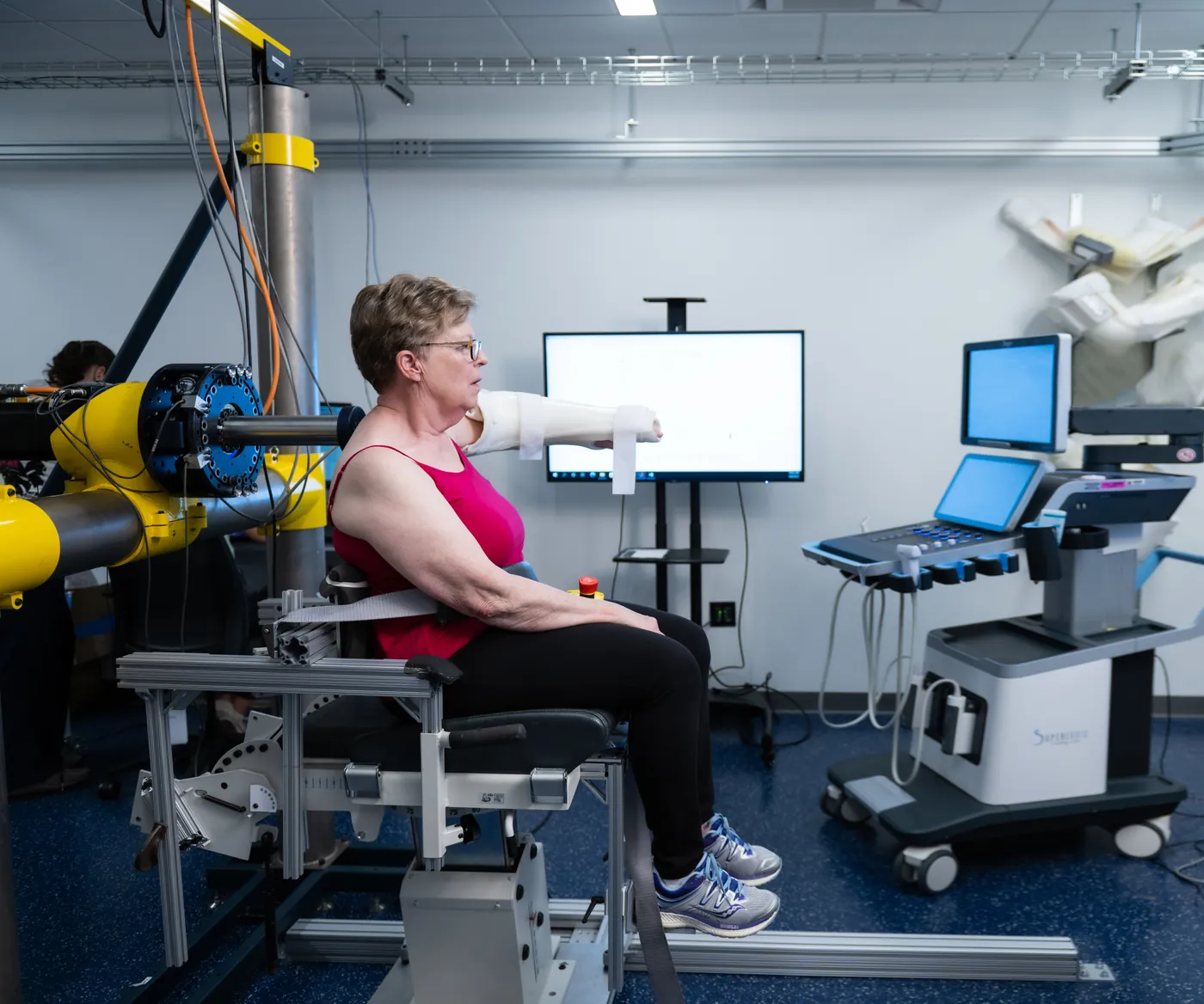
A participant performs a seated shoulder assessment with a robotic manipulandum in the MBIL laboratory.

Seeing Muscle Stiffness

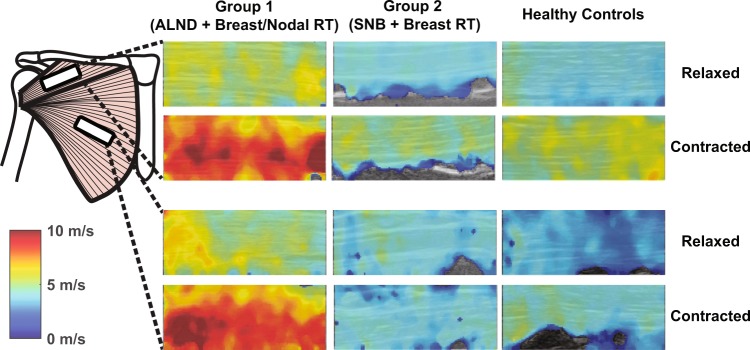
Ultrasound shear-wave elastography lets us map the stiffness of the pectoralis major directly in living tissue. Brighter regions indicate stiffer muscle. Comparing breast cancer survivors treated with different surgical and radiation approaches to healthy controls reveals how treatment reshapes the mechanical properties of the muscle — both at rest and during contraction.

Shear-wave elastography stiffness maps of the pectoralis major across breast cancer treatment groups and healthy controls, relaxed and contracted.
Shear-wave elastography maps of the pectoralis major across treatment groups. Lipps et al., Scientific Reports (2019) , CC BY 4.0.

Research Themes

Shoulder Morbidity After Breast Cancer Treatment

Mastectomy, breast reconstruction, and radiation therapy can compromise the strength, stiffness, and mobility of the shoulder. We quantify these neuromuscular and biomechanical changes to understand who is most at risk and why.

  • Shoulder biomechanics
  • Patient-reported outcomes
  • Survivorship

Pectoralis Major Mechanics & Shear-Wave Elastography

Using ultrasound shear-wave elastography, we measure the region-specific stiffness and material properties of the pectoralis major in vivo — revealing how the muscle changes with reconstruction, radiotherapy, age, and sex.

  • Shear-wave elastography
  • Muscle stiffness
  • In-vivo imaging

Radiation Dose to Shoulder Musculature

We quantify the radiation dose delivered to individual shoulder muscles during breast radiotherapy and link it to later changes in stiffness, pain, and function — informing muscle-sparing treatment planning.

  • Radiation dosimetry
  • Longitudinal follow-up
  • Treatment planning

Wearable Sensors for Shoulder Motion

We develop kirigami-inspired sensor patches and machine-learning models to estimate shoulder rotation and abduction, bringing objective movement assessment beyond the laboratory.

  • Kirigami sensors
  • Machine learning
  • Wearable technology

Myofascial Massage Interventions

Through a Phase 1 clinical trial, we are testing whether myofascial massage and patient–therapist communication reduce pain and alter tissue stiffness in breast cancer survivors with myofascial pain.

  • Clinical trial
  • Myofascial therapy
  • Pain & stiffness

Neck Muscle Mechanics & Chronic Pain

We investigate how chronic neck pain and posture influence the activity and elasticity of the upper trapezius and sternocleidomastoid, including the effects of cervical traction and ergonomic factors.

  • Neck biomechanics
  • EMG
  • Ergonomics

Selected Funding

Our research has been supported by the American Cancer Society, the National Institutes of Health, Susan G. Komen, and the University of Michigan.